
The Missing Link in Your Tech Stack: What is AI Enablement?
We are past the “wow” phase of Artificial Intelligence. Everyone has seen the magic trick. Now, businesses are asking the expensive question: “How do we actually make this work?”
Buying the Ferrari F1 team doesn’t automatically transform you into a race car driver; you need the intensive training, the highly skilled pit crew for support, and the actual track to compete on and hone your skills. The car is merely a tool, albeit a magnificent one, that requires a complete ecosystem to deliver its intended purpose of winning races.
Similarly, simply purchasing a subscription to advanced AI tools like ChatGPT Enterprise or GitHub Copilot doesn’t automatically make you an AI-driven company. The technology is just the vehicle. To truly become AI-driven, an organization must invest in and cultivate the equivalent of the “training, the pit crew, and the track”:
1. The Training (Skills and Literacy):
- Upskilling the Workforce: Employees, from leadership to the front lines, must be educated not just on how to use the tools, but on how to think with AI. This includes understanding AI’s capabilities, its limitations, ethical implications, and, most importantly, identifying high-value use cases within their specific domain.
- Data Fluency: An AI-driven company understands that AI models are only as good as the data they are trained on and fed. This requires investing in data governance, quality, and accessibility, ensuring the workforce is data-literate.
2. The Pit Crew (Infrastructure, Governance, and Process):
- Robust Data and Tech Infrastructure: The underlying technology stack must be capable of supporting large-scale AI deployment, data pipelines, and secure access. A powerful tool needs a powerful, reliable engine room.
- Clear AI Governance and Strategy: A cohesive, company-wide strategy is necessary, outlining where and how AI will create strategic value. This “pit crew” also develops the guardrails, policies, and ethical frameworks to ensure responsible and compliant AI usage.
- Integrated Workflows: AI tools cannot operate in a vacuum. They must be seamlessly integrated into existing business processes and workflows to drive meaningful operational change, not just sit on a shelf as an expensive novelty.
3. The Track (Culture of Experimentation and Change Management):
- Culture of Iteration and Experimentation: True AI transformation is not a one-time project; it’s a continuous journey. The culture must encourage safe, rapid experimentation, learning from failures, and scaling successes quickly—much like a race team constantly tuning its car based on track performance.
- Change Management: Introducing powerful new tools requires managing the human element. The organization must actively manage resistance to change, clearly communicate the value of AI, and redefine roles to ensure that AI augmentation leads to greater productivity and job satisfaction, not anxiety.
In essence, AI technology is a necessary, but not sufficient, condition for AI transformation. The real competitive advantage lies in building the complete organizational and cultural ecosystem that allows the powerful new tools to be wielded effectively, ethically, and at scale.
The gap between purchasing AI and profiting from it is called AI Enablement.
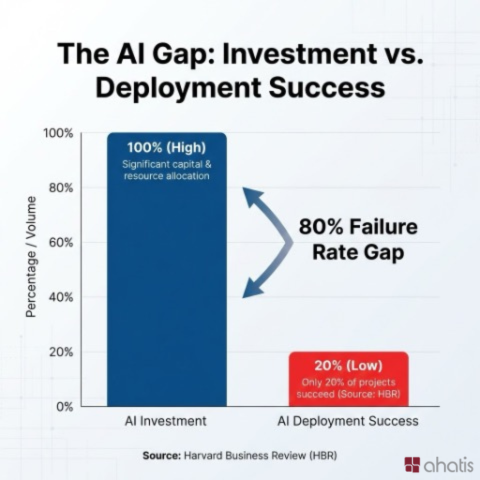
The Hard Truth: Why 80% of AI Projects Fail
According to the Harvard Business Review, nearly 80% of AI projects never reach full deployment. They die in the “pilot purgatory.” (“Keep your AI Projects on Track”) ↗
Why? Because companies treat AI as a software install rather than an operational overhaul. They underestimate the complexity of integrating these fluid, probabilistic models into rigid, deterministic legacy systems.
AI Enablement is the strategic framework—the process, technology, and culture—that bridges that gap. It is how you turn a cool tool into a competitive moat.
What Actually Is AI Enablement?
At its core, AI enablement is the process of creating an environment where AI can live, breathe, and work within your existing business.
It is not just about “giving people access.” It is about ensuring that access is:
- Useful (connected to real data)
- Safe (governed and compliant)
- Seamless (integrated into daily workflows)
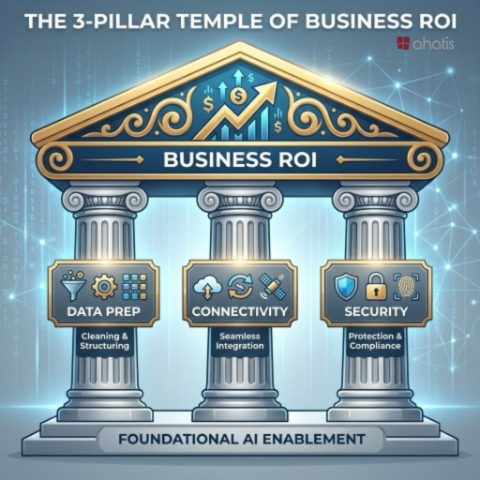
To get there, your strategy needs three pillars.
Pillar 1: Data Preparation (Feeding the Beast)
AI is only as smart as the data it eats. If you feed an LLM messy, unstructured, or siloed data, you get “hallucinations” and bad advice.
- The Fix: You must sanitize, classify, and tag your data before the AI touches it. Techniques like vectorization and semantic analysis are non-negotiable here.
Pillar 2: Seamless Connectivity (Breaking Silos)
An AI assistant that can’t see your CRM, your project management tools, or your internal wiki is just a fancy chatbot.
- The Fix: Robust connectors (APIs) that bridge the gaps between your AI models and your repositories. The goal is a “Single Pane of Glass” where the AI has a comprehensive view of the enterprise.
Pillar 3: Governance & Security (The Guardrails)
This is where most Legal and IT teams hit the brakes. Who sees what? Where does the data go?
- The Fix: Role-based access controls (RBAC) and encryption. You need a system where the Marketing Intern can’t accidentally query the CEO’s salary data via the company AI.
 pillar-temple
Why This Matters Now
The benefits of getting this right are massive. We aren’t just talking about “saving time.” We are talking about:
- Operational Velocity: Automating the 20% of work that takes 80% of the time.
- Generative Innovation: Using AI to model new business lines, not just summarize emails.
- Competitive Agility: The ability to switch models (e.g., from GPT-4 to Claude 3.5 to Gemini) as technology evolves without rebuilding your entire stack.
Real-World Wins
- Healthcare: Moving from generic diagnosis to personalized treatment plans by analyzing patient history at scale.
- Finance: shifting from reactive fraud checks to real-time predictive risk modeling.
- Retail: Supply chains that predict inventory shortages before they happen.
How to execute: Best Practices for 2026
If you are ready to move from “playing with AI” to “enabled by AI,” start here:
- Don’t “Boil the Ocean”: Pick one high-friction workflow to solve first. Prove the value there.
- Invest in “Human Enablement”: The best AI tool is useless if your team is afraid of it. Train them not just on how to use it, but why it helps them.
- Audit Your Data First: Before buying tools, clean your house.
- Define Ethics Early: Establish an AI ethics committee. Transparency builds trust.
The Bottom Line
AI enablement is no longer optional. The market is splitting into two groups: those who are waiting for AI to “stabilize,” and those who are building the infrastructure to exploit it now.
The technology is ready. Is your organization enabled?